

Herbert Berger: saxophone, clarinets
Walter Kortan: trumpet, vocals
Georg Schratenholzer: trombone
Markus Gaudriot: piano
Harry Putz: bass
Rudi Staeger: drums
Program
Sweet Georgia Brown
Please Don`t Talk About Me When I`m Gone
Creole LoveCall
St Louis Blues
Struttin` With Some Barbecue
On The Sunny Side Of The Street
Blue Moon
Bei Mir Bist Du Scheen
Ain`t Misbehavin
Honeysuckle Rose
In einem kleinen Cafe In Hernals
When Yourè Smiling
I Found A New Baby
The Austrian “Satchmo” left more than just his name behind in European traditional jazz
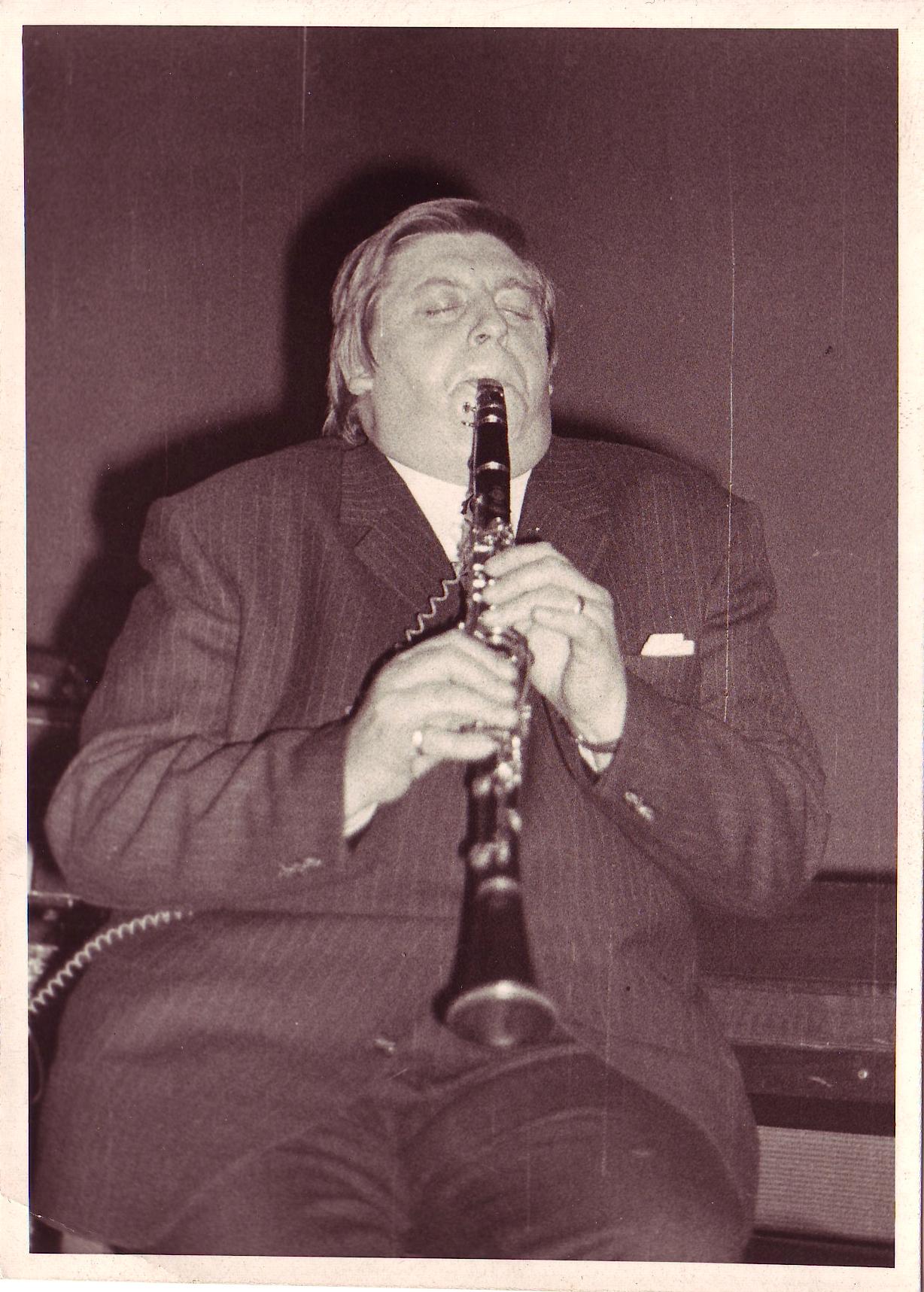
He was heavy in every sense of the word: physically, of course, but Fatty George was also one of the cornerstones of the Viennese music scene for decades. When it came to traditional jazz, the clarinetist, whose real name was Franz Georg Preßler, was always one of the top names in Europe. The great “Satchmo,” Louis Armstrong, is said to have once described Fatty's music as “wonderful, wonderful.” Friday (April 29) marks the 20th anniversary of the legendary musician's death. Franz Georg Preßler was born on April 24, 1927, in Vienna. He studied at the conservatory and the music academy in the Austrian capital. At the age of 18, immediately after the war, he began to cultivate his passion for American sound and performed first in Russian and then in US soldiers' clubs. In 1947, Fatty George began an interlude in Germany.
In addition to his reputation as one of Europe's best jazz clarinetists, the Viennese musician also made a name for himself as a founder of jazz clubs. After returning from Germany, he first opened “Fatty's Jazz Casino” in Innsbruck in 1952. From 1955 onwards, he lived in Vienna again, from where he undertook tours throughout Central Europe. In 1958, he opened “Fatty's Saloon” on Petersplatz in the federal capital—at that time Europe's largest jazz club. Jazzland Until 1963, Fatty and his band played there, of course, but there were also regular sessions with big names such as Lionel Hampton, Ella Fitzgerald, Art Blakey, and John Lewis. In 1964, George had to close the club for the first time, and even later he was only able to maintain continuous operation in phases. In the 1970s, the clarinetist played at the newly founded Jazzland club near Ruprechtskirche. On March 29, 1982, he died at the age of 54 after a long serious illness. Fatty George owed his fame to swing, celebrating the tradition of jazz with technical perfection. In addition, he also ventured into more modern styles, working with Hans Koller, Friedrich Gulda, and Joe Zawinul, among others. Throughout his life, the clarinetist felt a deep connection between jazz and Viennese folk songs. A musical, “Walzer in Moll” (Waltz in Minor), remained unfinished. Why he preferred the American sounds to the music of his hometown—Fatty George kept this secret to himself. In any case, he was an invaluable asset to European jazz. (APA, March 28, 2002)
The energetic drummer and producer Rudi Staeger is organizing a tribute to mark the 100th birthday of the master clarinetist. Welcome to the club!
https://www.musiklexikon.ac.at/ml/musik_F/Fatty_george.xml